
Table des matières
Stepper motors are at the heart of countless automated systems, powering everything from 3D printers and CNC machines to medical devices and camera positioning rigs. They offer precise control over movement without the need for complex feedback systems, which is one reason they remain popular across industries. One critical characteristic that influences their design, operation, and performance is the number of phases.
This factor affects how the motor is driven, its smoothness of motion, torque output, and even cost. To fully appreciate the role of phases in stepper motors, it’s important to understand what stepper motors are, how phases are defined, how to identify them, and whether having more phases automatically means better performance.
1. What is a stepper motor?
A stepper motor is a type of brushless DC electric motor that divides a full rotation into a series of equal steps. Unlike traditional DC motors, which rotate continuously when voltage is applied, stepper motors move in discrete angular increments. Each step corresponds to a specific movement of the rotor, and by energizing the motor coils in a controlled sequence, the motor can achieve precise positioning without the need for encoders or other feedback mechanisms.
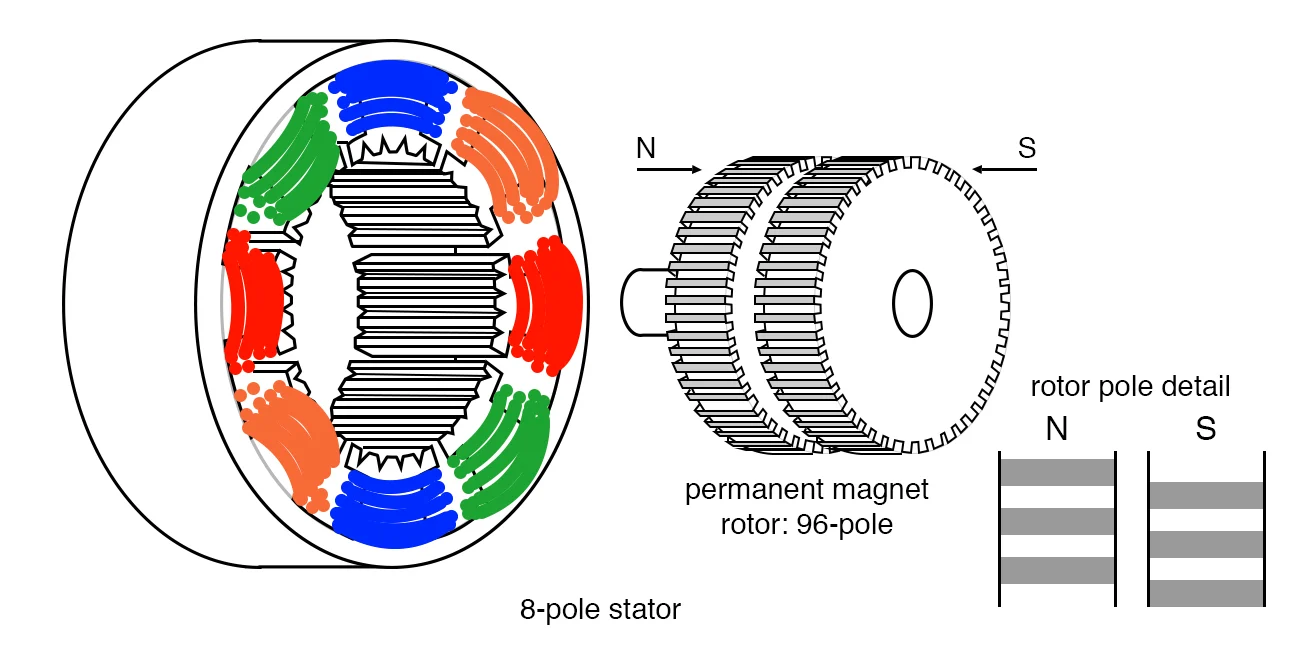
The basic construction of a stepper motor includes a stator (the stationary outer section) and a rotor (the rotating inner section). The stator houses multiple coils, which are organized into phases. These coils, when energized in a specific order, create magnetic fields that pull or push the rotor into position. The rotor often contains permanent magnets or soft iron teeth designed to interact with the changing magnetic fields produced by the stator windings.
In industrial and commercial use, stepper motors are prized for their repeatability. Commanded to move a certain number of steps, they can do so consistently and accurately. This makes them ideal for applications like robotics arms, precision cutting equipment, and semiconductor manufacturing tools. However, their performance characteristics as torque, vibration, and speeddepend heavily on design factors, one of the most important being the number of phases in the motor’s winding configuration.
2. What is the number of phases of a stepper motor?
In the context of stepper motors, a “phase” refers to a group of coils within the stator that are energized together to produce a magnetic field. These phases are the motor’s “control channels,” and each one must be powered in a precise sequence to make the rotor move from one position to the next. The number of phases in a stepper motor simply indicates how many separate coil groups the motor contains, and therefore how many separate electrical waveforms or circuits are needed to drive it.
The idea is easier to grasp if you imagine the rotor as being pulled forward by different teams of magnetic “hands.” Each phase is one team. When Phase A is energized, its magnetic field pulls the rotor into a certain alignment. Then Phase B is energized, pulling the rotor a little further. If there is a third or fifth phase, those phases add intermediate pulls, creating smaller, smoother steps. The more “teams” you have, the more evenly the work is shared, and the more continuous the movement feels.
Stepper motors are different from standard DC motors in that they require phased excitation to move at all. If only one phase were present, the motor could only lock into a single magnetic positionit would not rotate. Multiple phases allow the magnetic field to be rotated electronically, which forces the rotor to follow along in discrete steps. The motor driver determines the order and timing in which these phases are energized, and this sequence is known as the stepping sequence.
The most common phase configurations in stepper motors are two-phase, three-phase, and five-phase. Two-phase motors dominate general use because they strike a practical balance between cost, control complexity, and performance. Three-phase and five-phase motors are designed for smoother rotation and finer positioning, but they require more sophisticated electronics and are often reserved for high-end applications.
It’s important to note that the number of phases is fixed by designyou cannot “convert” a two-phase motor into a five-phase motor by changing wiring. The coils are physically wound in a specific arrangement during manufacturing, and this arrangement determines the phase count.
From a performance standpoint, more phases typically mean:
● Reduced step angle (higher native resolution without microstepping).
● Smoother rotation with less torque ripple.
● More stable torque output over a wider speed range.
However, more phases also mean more control lines, more expensive drivers, and potentially larger connectors or more complicated wiring harnesses. This is why in industrial design, the number of phases is always chosen to match the application’s precision requirements, budget, and space constraints.
3. How to distinguish the phase number of stepper motor?

Identifying the number of phases in a stepper motor can be crucial when replacing or integrating it into a system, especially if the original documentation is unavailable. While manufacturer datasheets remain the gold standard for obtaining this information, practical inspection and testing methods are often needed in the field.
When you can access the motor’s technical datasheet, you will often find the phase number clearly listed, alongside other key specifications such as coil resistance, current rating, and step angle. But in cases where the datasheet is missingperhaps the motor was salvaged from old equipmenthands-on investigation becomes necessary.
A visual inspection of the wiring can offer clues. The number of external leads is one of the first things to look at. For example:
● Two-phase stepper motors often have 4, 6, or 8 wires.
● Three-phase motors tend to have 3 or 6 wires.
● Five-phase motors might have 5 or 10 wires.
However, the wire count alone can be misleading because of variations in internal wiring configurations. This is why electrical testing is often the more reliable approach. Using a multimeter set to measure resistance, you can determine which wires belong to the same coil group. A two-phase motor will have two distinct coil pairs, each with equal resistance values. A five-phase motor will show five coil pairs, and so forth.
In addition to wire analysis, the motor driver or controller can be a useful indicator. Most stepper drivers are built for a specific number of phases and will be labeled accordingly. If your driver is a dedicated five-phase model, it will not work with a two-phase motor, which makes compatibility checks critical during repairs or upgrades.
In industrial maintenance environments, technicians sometimes use oscilloscopes or signal analyzers to observe the current patterns being sent to the motor. This advanced method can confirm phase count while also verifying that the driver is sending the correct sequence of pulses.
Ultimately, combining visual inspection, resistance testing, and driver specification analysis provides the most reliable way to identify a motor’s phase number without factory documentation.
4. Common phase types of stepper motors
While stepper motors can theoretically be designed with many different phase configurations, the industry has converged on a few standard types because they balance manufacturing complexity with performance needs. The most common are two-phase, three-phase, and five-phase stepper motors.
Two-phase stepper motors
Two-phase motors dominate the market because of their excellent balance of simplicity, cost-effectiveness, and adequate performance for most applications. Available in both bipolar and unipolar winding configurations, they are versatile and supported by a wide variety of affordable driver electronics.
Bipolar two-phase motors generally produce more torque for a given winding size because the full coil is always used in each energizing cycle. They require more complex driving circuits with H-bridges to reverse the current direction. Unipolar versions, while slightly less efficient in torque generation, have simpler driving requirements and can be easier to control in basic applications.
With a typical step angle of 1.8° per full step (200 steps per revolution), two-phase motors offer a good compromise between speed and resolution. Using microstepping techniques, where the driver modulates current to intermediate levels, the movement can be made significantly smoother, reducing mechanical resonance and improving accuracy in sensitive tasks.
Three-phase stepper motors
Three-phase stepper motors are chosen for their smoother motion and reduced vibration compared to two-phase models. By having three magnetic fields overlapping in phase sequence, torque ripple is significantly reduced, which can be important in applications such as optical scanning or high-precision printing.
They often feature a 1.2° step angle (300 steps per revolution), allowing for finer native resolution. The torque curve tends to be more stable across a range of speeds, which can lead to better performance in continuous motion tasks. However, the downside is the need for more sophisticated driver electronics, which can increase overall system cost.
Five-phase stepper motors
Five-phase motors are the premium option for ultra-precise motion control. Their standard 0.72° step angle (500 steps per revolution) allows exceptionally fine resolution without depending entirely on microstepping. This is advantageous in systems where even minor positioning errors are unacceptable, such as semiconductor wafer alignment, surgical robotics, or intricate CNC milling.
The five-phase design also nearly eliminates torque ripple, producing incredibly smooth rotation. However, this comes at the cost of increased wiring complexity and the requirement for specialized, higher-cost drivers. For applications where precision and smoothness matter more than cost efficiency, five-phase motors are often worth the investment.
5. Does the larger the number of phases, the better the performance of the stepper motor?
It might seem intuitive to assume that the more phases a stepper motor has, the better its performance. While there is some truth to this, the relationship is not absolute and depends on the specific performance metrics being considered.
Increasing the number of phases generally reduces torque ripple, leading to smoother motion. For instance, a five-phase motor will usually produce a more consistent torque output and less vibration than a two-phase motor. This is particularly advantageous in applications requiring high-precision positioning or smooth surface finishes, such as engraving or high-speed printing.
More phases can also mean finer step angles, which improve resolution. This allows the motor to achieve smaller, more accurate movements without relying solely on microstepping, which can sometimes reduce available torque.
However, there are trade-offs. Motors with more phases require more complex drivers, which increases cost and sometimes reduces system efficiency. A five-phase motor, for example, not only costs more to purchase but also demands a specialized driver that can handle the additional control lines. For many general-purpose applications, a well-driven two-phase motor with microstepping can achieve sufficiently smooth motion at a lower cost.
Additionally, more phases don’t necessarily mean more torque. Torque output is influenced by factors such as winding design, current capacity, magnetic materials, and rotor geometry. In some cases, a two-phase motor with optimized windings and a high-quality driver can outperform a higher-phase motor in terms of raw torque.
Conclusion
The number of phases in a stepper motor is far more than a mere technical detailit shapes the motor’s behavior, influences its compatibility with control electronics, and determines its suitability for various applications. From the widely used two-phase designs to the precision-oriented five-phase models, each configuration brings a unique set of strengths and trade-offs.
Identifying the correct phase count is essential when replacing or integrating a stepper motor into any system. While datasheets remain the most reliable source, careful inspection of wiring, resistance testing, and examination of the driver hardware can also provide accurate identification.
When it comes to performance, more phases generally mean smoother motion and finer resolution, but not always higher torque. The choice should always align with the application’s demands, balancing the need for precision, smoothness, cost, and complexity.
 French
  English
  Arabic
  Spanish
  Portuguese
  Italian
  German
  Vietnamese
  Thai
Thai  Chinese
  Turkish
  Japanese
  Korean
  Russian