× › Products

Types of Stepper Motors

Stepper motors are categorized into three main types: Variable Reluctance (VR), Permanent Magnet (PM), and Hybrid (HB).

Stepper motors are critical components in numerous applications requiring precise control of mechanical movements. From robotics to industrial machinery, these motors enable exact positioning and repeatable actions by converting electrical pulses into mechanical motion. Stepper motors are categorized into three primary types: Variable Reluctance (VR), Permanent Magnet (PM), and Hybrid (HB). Each type possesses unique characteristics that make them suitable for different applications. This article explores the intricacies of each type, their working principles, and their specific advantages and disadvantages.

Variable Reluctance (VR)

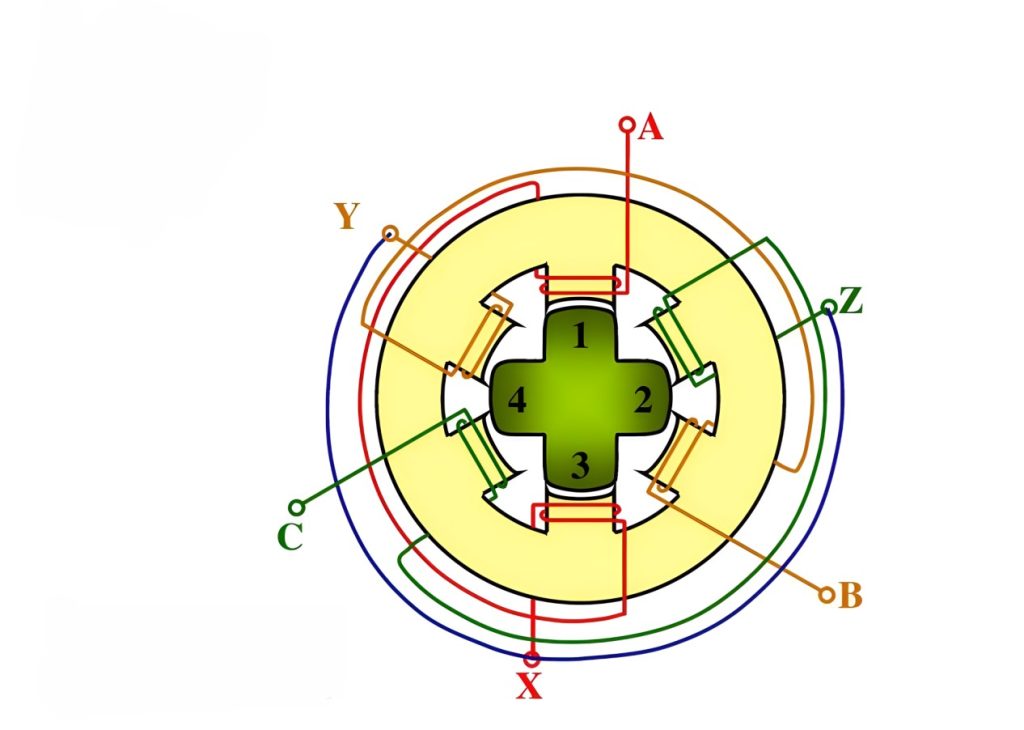
  • Operating Principle: The VR stepper motor operates by the interaction between a magnetic rotor core and a pulsed electromagnetic field generated by the stator.
  • Construction: The rotor has numerous small teeth evenly distributed around its circumference, while the stator has teeth with three excitation windings. The geometric axes of the stator teeth are staggered in relation to the rotor teeth.
  • Functionality:
    • The motor’s position and speed correspond directly to the number of pulses and their frequency.
    • The direction of rotation is determined by the sequence in which the windings are energized.
  • Characteristics:
    • Typically three-phase.
    • Capable of achieving high torque output.
    • Step angle is typically 1.5 degrees.
    • Produces significant noise and vibration.

Permanent Magnet (PM)

  • Operating Principle: PM stepper motors use a permanent magnet rotor that interacts with the electromagnetic field produced by the stator.
  • Construction: The rotor is made of a permanent magnet, which can be of various shapes (cylindrical, disc, etc.), and the stator has multiple windings.
  • Functionality:
    • The rotor aligns with the magnetic field generated by the stator windings.
    • The motor steps when the current in the windings is switched.
  • Characteristics:
    • Typically two-phase.
    • Lower torque compared to hybrid stepper motors.
    • Step angles usually range from 7.5 to 15 degrees.
    • Less noisy and smoother operation than VR motors.

Hybrid (HB)

  • Operating Principle: Hybrid stepper motors combine features of both VR and PM motors, utilizing both a permanent magnet and toothed electromagnets.
  • Construction: The rotor includes a permanent magnet core with toothed iron laminations, and the stator has corresponding teeth and windings.
  • Functionality:
    • Offers precise positioning and high torque.
    • The combination of permanent magnets and toothed structures enhances performance.
  • Characteristics:
    • Typically available in two-phase or five-phase configurations.
    • Step angles can be as small as 0.9 degrees.
    • Provides high resolution and accuracy.
    • Produces moderate noise and vibration, balancing the features of VR and PM motors.

Request a Quote

Servo drives and motors are widely used in automation industry

We ensure that our temperature monitoring sensors are all calibrated to the highest quality standards for the industry. Record the most accurate data with our in-house A2LA lab-certified probes and make meeting compliance the easiest part of your day.

A2LA Accredited & NIST Traceable Calibration

Enterprise Scalability

Government-Grade Security

Products Engineered to Exceed Compliance

This is the heading

This is the heading

en_USEnglish