
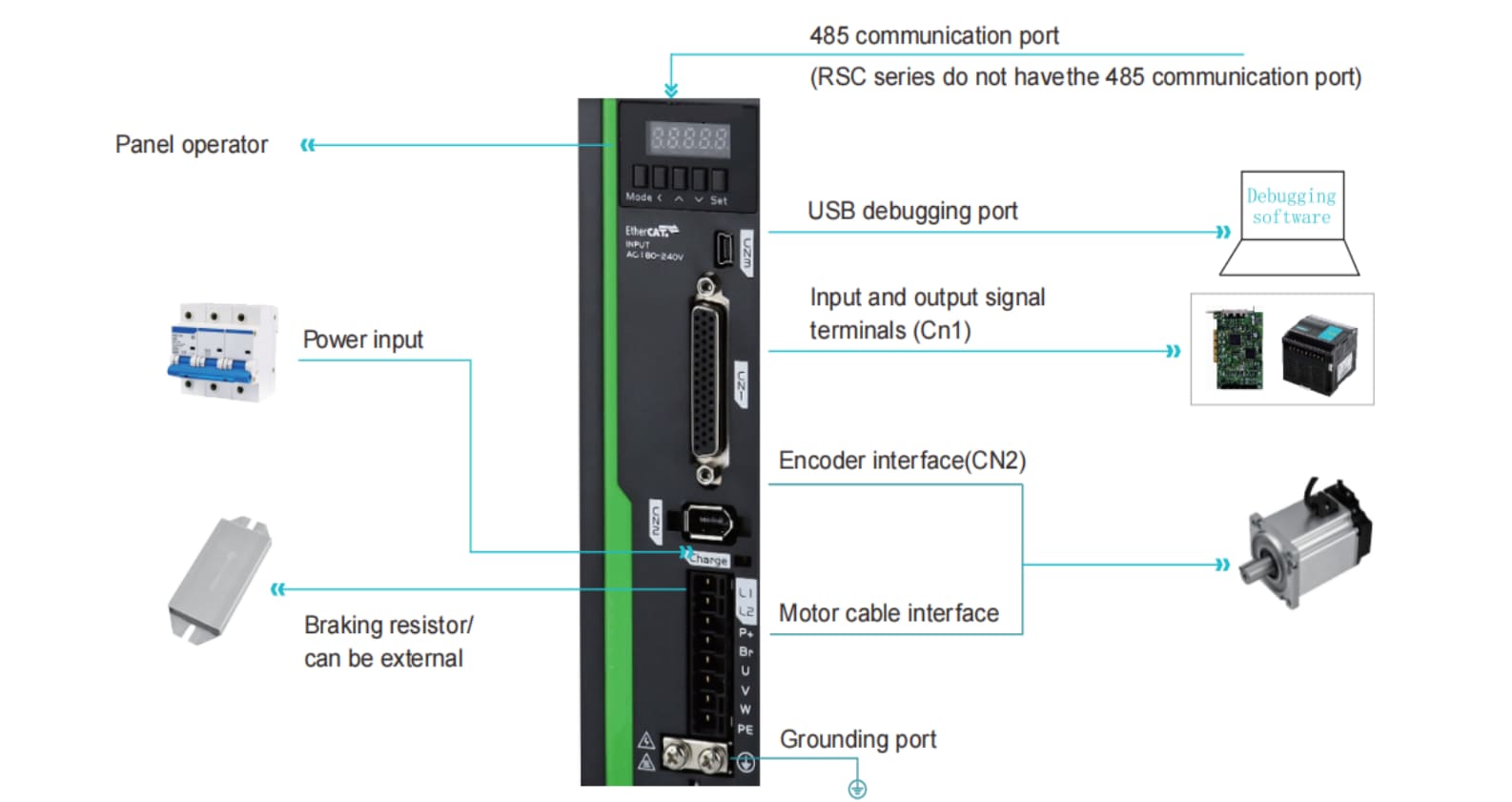
Choosing the right servo drive for a motor requires careful consideration of several factors to ensure optimal performance and compatibility. Here’s a step-by-step guide to help you choose the right servo drive for your motor:
- Understand Motor Specifications: Start by understanding the specifications of your motor. Key parameters to consider include:
- Voltage and current ratings: Ensure that the servo drive is compatible with the voltage and current requirements of the motor.
- Motor type: Determine whether your motor is a brushed DC motor, brushless DC motor, AC induction motor, or synchronous motor, as different types may require different drive technologies.
- Speed and torque requirements: Consider the desired speed, torque, and acceleration capabilities of the motor for your application.
- Consider Control Requirements:
- Determine the control interface required for your application, such as analog voltage, pulse and direction, serial communication (e.g., RS-232, RS-485, CAN), or Ethernet-based protocols (e.g., EtherCAT, PROFINET).
- Ensure that the servo drive supports the control interface used by your motion control system or PLC.
- Evaluate Feedback Requirements:
- Determine whether your application requires position or velocity feedback for precise motion control.
- Select a servo drive that supports the feedback device (e.g., encoder, resolver) and feedback resolution required for your application.
- Assess Performance Requirements:
- Consider the dynamic performance requirements of your application, including acceleration, deceleration, and settling time.
- Choose a servo drive with sufficient power output and control bandwidth to meet the performance requirements of your motor and application.
- Review Additional Features:
- Evaluate additional features and capabilities offered by the servo drive, such as:
- Safety features: Overcurrent protection, overvoltage protection, thermal protection, and fault detection mechanisms.
- Tuning and auto-tuning capabilities: Some servo drives offer automatic tuning algorithms to simplify setup and optimize performance.
- Communication options: Consider whether the servo drive supports communication with other devices or networks for data monitoring, diagnostics, and control.
- Evaluate additional features and capabilities offered by the servo drive, such as:
- Consider Environmental Factors:
- Consider environmental factors such as temperature, humidity, and vibration levels in your application environment.
- Choose a servo drive with appropriate environmental ratings (e.g., IP rating) and rugged construction to withstand the operating conditions of your application.
- Evaluate Cost and Budget:
- Consider the cost of the servo drive and ensure that it fits within your budget constraints.
- Balance the cost with the performance, features, and reliability offered by the servo drive to determine the best value for your application.
By carefully evaluating these factors and selecting a servo drive that meets the requirements of your motor and application, you can ensure reliable and efficient operation of your motion control system. If you’re unsure about any aspect of choosing a servo drive, consult with a knowledgeable supplier or engineer for assistance.
 English
  Arabic
  Spanish
  Portuguese
  Italian
  French
  German
  Vietnamese
  Thai
Thai  Chinese
  Turkish
  Japanese
  Korean
  Russian