

Table of Contents
Stepper motors are widely used in automation, robotics, 3D printing, CNC machines, and countless other applications where precision movement is essential. Since they move in discrete steps, they become crucial for precise positioning due to repeated movements.
Without a driver, the motor will not be of any use to you. Many common questions arise in the minds of beginners or hobbyists; some say, Can you run a stepper motor without a driver?
In this article, we will learn about the major workings of stepper motors, the purpose of a driver, why drivers are so important, whether a single driver can control several motors, and how to pick the perfect one for you.
Part 1. Working Principle of Stepper Motor
Stepper motors operate on the basic electromagnetic principle, which means the conversion of electrical pulses to precise mechanical actions. In construction, these motors are made in such a way that they rotate in fixed angular increments called “steps” along the given energization of the windings in one particular sequence. Through such stepwise rotation of the motor, the system is ideal wherever accurate positioning and repeatable motion are considered.

A typical stepper consists of two parts: the stator and the rotor.
- The rotor is a permanent magnet, or it could be a toothed sham iron core, which reacts to magnetic fields.
- The stator surrounds the rotor, with several windings or coils arranged circularly and energized in a particular pattern to give a rotating magnetic field.
Current passing through the stator winding produces a magnetic field. Energizing the windings in sequence produces a field that rotates inside the stator. The rotor rotates in steps under the push-pull forces of the magnetic field to align itself with the direction of the magnetic field.
A stepper motor operates one step each time the energizing sequence progresses; the rotor thus moves one step further in controlled, repeatable movements. The actual point-to-point traveling action and torque characteristics of the stepper motor greatly depend on the energizing method being used, or in other words.
Here are three commonly used driving modes:
- 1.Full Step Mode: Two phases are energized simultaneously. This causes the rotor to move in full steps, which are typically 1.8° per step. This mode gives higher torque but comparatively rough motion.
- 2.Half Step Mode: Here, the excitation is alternated between one phase and two phases, resulting in smaller steps, typically 0.9°. It offers smoother operation and a compromise between torque and resolution.
- 3.Microstepping Mode: This is the most advanced form of drive, where multiple windings are partially energized simultaneously with well-controlled amplitude relationships.
Microstepping allows the rotor to turn in a highly smooth fashion at a very fine resolution, usually less than a degree fraction. Generally, the torque available under microstepping is much lower than that in full-step operation.
Part 2: How Does the Driver Control the Stepper Motor?
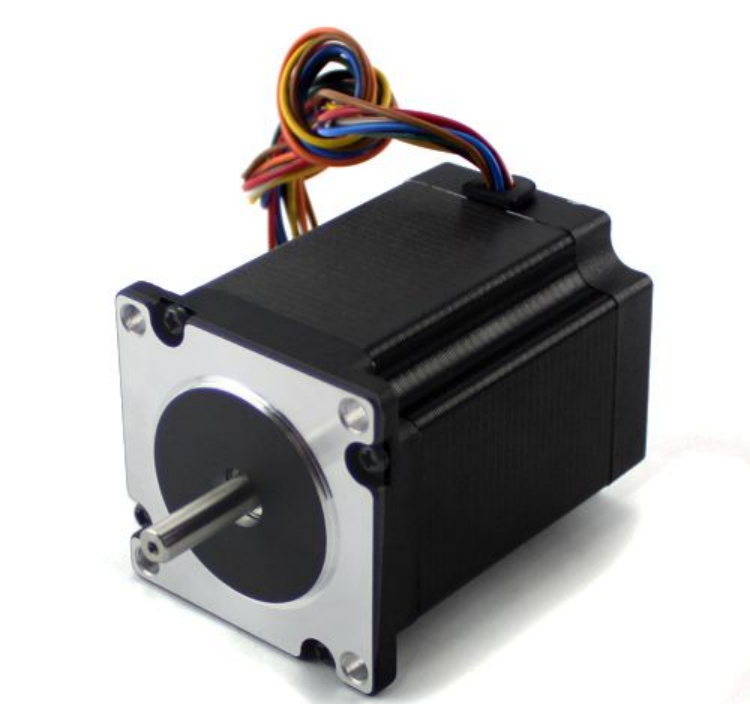
Stepper motor drivers are specialized devices typically positioned between the control system, such as a microcontroller or programmable logic controller (PLC), and the motors themselves. They can receive small control signals and convert them into large electrical pulses that energize the motor windings in a precise sequence, allowing the rotor to move exactly from one step to the next.
You cannot run the stepper by merely applying voltage across its terminals. Instead, the driver energizes one coil, then the second or third, or however many exist in the set sequence, for so many milliseconds with the specified current. It is this set sequence that creates the rotating magnetic field in the stator; the rotor then has to follow in discrete steps.
Most stepper motor drivers accept two basic signals from a controller:
Step (Pulse): A pulse is sent to move the motor one step forward or backward.
Direction:This signal tells the driver in which direction to rotate the motor.
At the receipt of the pulse signal, the driver activates the appropriate windings in the direction of initiation, consistent with the step in the sequence. This ensures the rotor moves in the desired direction with the appropriate increment.
Part 3. The Importance of Drivers to Stepper Motor Operation
Stepper motors are most appreciated for their accuracy, dependability, and capacity to move in distinct, repeatable steps. But a stepper motor won’t operate as intended without the correct driver. Let’s discuss the reasons why stepper motor drivers are necessary for correct motor operation.
1. Exact Step Control
The capacity of the stepper motor’s core to turn the motor shaft in set angular increments, referred to as steps, defines its operation. Every step calls for the stator windings to be powered in a precise sequence.
Manual or direct control via the I/O pins of a controller is impossible for this sequence, which is far too intricate. The stepper motor driver guarantees the motor turns precisely as needed by producing timed electrical impulses based on input signals (step and direction), therefore managing this sequence effectively. Almost impossible to have exact control over rotation without a driver.
2. Current Regulation
Stepper motors draw current as long as they are standing, to keep the holding torque. Drivers regulate the current so the motor does not overheat and reach the rated specifications. Advanced drivers usually use chopper circuits or have current-limiting capabilities for safe and efficient operations when under varying load conditions.
3. Microstepping Control
Microstepping is a technique that allows the driver to change the current running through each coil in tiny increments, forcing the motor to make sub-steps between the full-step positions. It modulates the voltage to the windings using PWM (Pulse Width Modulation), hence generating smoother movements with less vibration and better resolution.
4. Protection Features
Built-in protection systems, including overvoltage, undervoltage, overcurrent, and thermal protection, are offered by excellent quality drivers. These safety measures guard the motor as well as the driver from harm brought on by system failures or electrical issues.
5. Advanced Drivers' Communication and Feedback
Some contemporary drivers provide diagnostic feedback and include communication interfaces like UART, CAN, or SPI so that closed-loop control systems may modify motor behavior in real-time for better accuracy and dependability.
Part 4. Can One Driver Control Multiple Stepper Motors?
A common question in multi-axis systems or robotics projects is whether a single driver can control multiple stepper motors. The short answer is: technically possible in limited cases, but generally not recommended for independent motor control. To understand why, we need to explore how stepper motor drivers work and what’s required for precise motion control.
Stepper motor drivers are built to manage the current flow and energizing sequence of one motor at a time. This implies they control current levels, maintain timing accuracy, and deliver the appropriate pulses to each coil in a certain order. These control components become shared when more than one motor is linked to a single driver, therefore greatly restricting the capacity to run the motors independently.
Should you attempt to join two stepper motors in parallel to one driver, both motors will simultaneously get the same pulse signal. Thus, they will spin in the same direction, at the same speed, and with the same step count.
This arrangement may work if:
- The electrical specifications of both engines are the same.
- The mechanical loads on both motors are about equal.
- They have to constantly execute the same synchronized movement.
They should perform the synchronized motions simultaneously at all times.
However, there are limitations and hazards:
- 1.Uneven Load Sharing: If two motors are driving different loads, one may stall and miss steps due to the imbalance in torque.
- 2.Current Mismatch: Motors may consume different currents, and the driver will not be able to adjust the output voltage for each motor individually. Hence, one motor may face risks of overheating or underdriving.
- 3.Poor Performance:Direction, speed, and position cannot be controlled individually for each motor, limiting the flexibility of the system.
If such mechanisms require independent control of several stepper motors, such as in 3D printers, CNC machines, or robots, each motor needs to be connected to its expressly dedicated driver. By this, one can have full control over each axis or motion path and avoid problems with power and synchronization.
Some high-end multi-axis drivers/motion controller boards perform the control of multiple motors from a single board, but still have separate driver circuits for each motor. Such types are made for coordinated control and often provide communication protocols and feedback mechanisms.
Part 5. How to Choose the Right Driver for Your Stepper Motor
Choosing the right driver for your stepper motor is necessary to ensure dependable performance, precision, and safety. There is a gamut of different drivers in the market, prompting the need to look at some major factors before making your purchase.
1. Matching Voltage and Current Ratings
Check the motor voltage and current rating first. The driver should carry a motor current at a rated value for each phase (or more if current limiting is available) and work within its voltage range. A driver with an insufficient current rating will result in weak torque, whereas current beyond what is rated will cause overheating or damage to the motor.
2. Select the Appropriate Step Mode
Drivers come in various step modes:
- 1.Full-step and half-step drivers are simple but tend to produce rougher motion.
- 2.Microstepping drivers provide smooth and quiet motion with much higher resolution by subdividing the steps into several levels.
For microstepping, which is strictly defined by 32 microsteps per full step, it comes into consideration for applications that require precision, such as 3D printing or CNC milling. These drivers must have at least 1/16 or 1/32 microstepping capacity for better performance.
3. Check for Compatibility With Control Signals
Your driver must be compatible with your controller or microcontroller (like an Arduino, Raspberry Pi, or while working with industry PLCs). Most stepper drivers accept step and direction signals; however, some may take their control commands via UART, SPI, or even I²C communication. Make sure your controller can send the appropriate signals to your driver for smooth integration.
4. Consider Features and Protection
A good stepper motor driver offers good protection to your driver, i.e., it will have its own set of protection built in. It’s worth considering:
- Over-temperature protection
- Over-current protection
- Under-voltage lockout
- Short-circuit protection
These will increase the lifetime of your motor and the entire system, especially when the load is severe or varies.
5. Thermal Design and Heat Dissipation
While these devices are operating, they will produce heat; take care, too, that the stepper driver has a good thermal design. Look for one with a heatsink, fan headers, or thermal shutdown.
6. Scalability and Expandability
Finally, if you plan to control multiple motors or expand your project later, consider driver boards that support multiple axes or modular setups. Multi-axis driver boards often include synchronized timing and shared power management, making system expansion more efficient.
Conclusion
Stepper motors act as heavy machinery for accomplishing precise and repeatable motion in a plethora of applications, robotics, 3D printing, and in the automation industry. But stepper motors cannot work efficiently or safely without a compatible driver having similar or suitable capabilities that convert control signals into timing, direction, and current required by one step of motor movement.
As we saw, the motor is liable to performance difficulties, heating, or even equipment damage if one attempts to run a stepper motor without a driver, or uses one driver for more than one stepper motor. The choice of the driver, thus, hinges upon the careful appraisal of the motor’s electrical specs, the nature of control needed for the application, and the environment in which the whole system is to be used.
 English
  Arabic
  Spanish
  Portuguese
  Italian
  French
  German
  Vietnamese
  Thai
Thai  Chinese
  Turkish
  Japanese
  Korean
  Russian