

目录
In modern automation, robotics, and precision control systems, stepper motors are essential for accurate positioning. Whether in 3D printers, CNC machines, or robotic arms, these motors often serve as the backbone of controlled movement. A common question among engineers and enthusiasts is whether two stepper motors can be driven in parallel.
At first glance, it seems straightforward. However, this topic has layers of complexity and demands deeper understanding. To better understand it, we first need to explore how stepper motors function and what happens when they are paired together.
1. Working Principle of Stepper Motor
Stepper motors operate based on electromagnetic principles. Unlike traditional motors that rotate continuously, stepper motors move in distinct increments. These precise steps make them suitable for applications requiring accurate position control.
Each pulse sent to a stepper motor causes it to move a specific angle, known as a step. The motor’s resolution is defined by how many steps it takes to complete one full rotation. More steps mean finer resolution and more precise movements.
This design enables extremely accurate control over the motor’s position. That’s why stepper motors are widely used in industries that rely on repeatable accuracy. The accuracy is deterministic, and the motion is fully controlled by the input pulse count.
Inside a stepper motor, the rotor can either be a permanent magnet or operate on variable reluctance. The stator is equipped with multiple windings that are energized in a particular sequence to move the rotor in small steps.
When current flows through the windings, it creates a rotating magnetic field. This magnetic field attracts the rotor, causing it to move incrementally as each winding is energized in order. The coordination between winding energizing and rotor movement is what creates the step-by-step rotation.
One unique aspect of stepper motors is their ability to maintain a position even when stationary. As long as current flows through the windings, the rotor resists movement due to the holding torque produced. This eliminates the need for complex feedback mechanisms like encoders in many cases.
2. How Do Two Stepper Motors Work in Parallel?
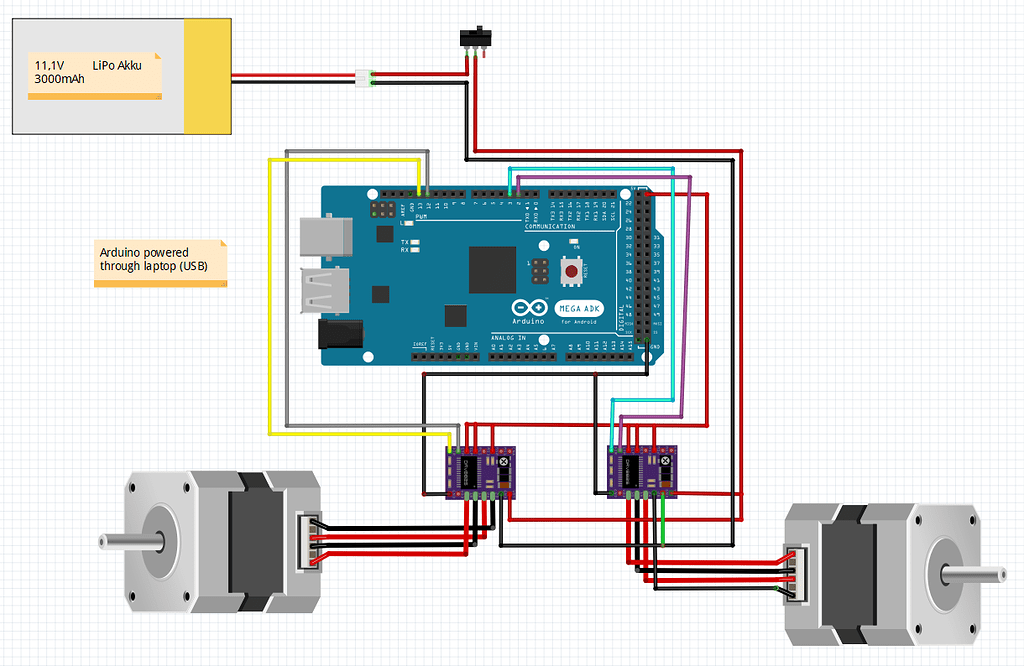
When two stepper motors are connected in parallel, both are wired to the same stepper driver. Each motor’s phase wires are joined to the corresponding wires on the other motor. This means the driver sends identical electrical signals to both motors at the same time.
This setup allows the motors to operate in sync, assuming that both motors are the same model and have identical electrical characteristics. Because they receive the same pulses, they should rotate together in harmony under ideal conditions.
Matching Motor Characteristics
Synchronization heavily depends on the motors being identical. Even slight differences in their specifications like internal resistance, inductance, or step angle—can cause one motor to move slightly faster or slower than the other. This leads to uneven movement, skipped steps, or mechanical misalignment over time.
To avoid such issues, both motors should be matched exactly. Using motors from the same manufacturer and batch can help minimize these internal differences and improve synchronization.
Power Requirements and Driver Limitations
Running two stepper motors from one driver means the driver must provide enough current for both. For example, if each motor needs 1.5 amps to operate properly, the driver must supply at least 3 amps in total. If the driver falls short, it may overheat, underperform, or even cause the motors to stall or skip steps.
Choosing a driver that supports higher current output is key to ensuring both motors operate smoothly without power issues.
Load Distribution and Mechanical Balance
Even if both motors are receiving the same signals and have the same specs, they must also carry the mechanical load evenly. If one motor experiences more resistance—perhaps due to friction, uneven weight, or alignment problems it might lag behind or lose steps.
To keep both motors moving in sync, the load they drive should be well-balanced. Proper alignment and equal tension across all moving parts help reduce strain on one side and maintain consistent motion.
Real-World Applications
One common use case for parallel stepper motor setups is in 3D printers especially for lifting the Z-axis. Since the loads are usually light and perfectly timed synchronization isn’t always critical, this setup is practical and cost-effective.
However, for applications requiring high precision or involving heavy or variable loads, using independent drivers for each motor is often a better choice
3. What Should Be Paid Attention to When Two Stepper Motors Work in Parallel
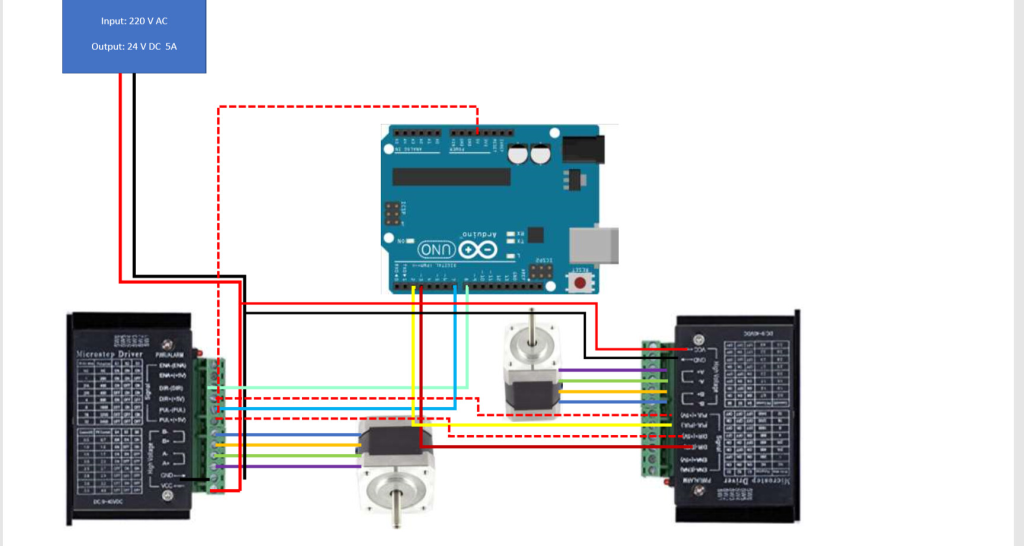
1. Matching Motors Perfectly
For two stepper motors to work reliably in parallel, they must be exactly the same. This doesn’t just mean using the same brand and model number. Their internal specs electrical resistance, inductance, and torque profile must also match. If you use mismatched motors, even minor differences can throw off synchronization, leading to skipped steps and mechanical stress.
2. Ensuring the Driver Can Handle the Load
The stepper driver needs to supply enough current for both motors combined. If each motor draws 2 amps, then the driver must be rated for at least 4 amps. Using a driver that can’t handle this combined load can cause overheating, erratic motion, and performance instability. Always confirm your driver specs before setting up the system.
3. Uniform and Proper Wiring
Wiring affects signal timing and voltage consistency. Both motors should be wired using the same gauge of wire, and the wire lengths should be equal. If one motor has a longer wire, it may receive slightly delayed or weakened signals, which could disrupt timing and cause one motor to lag behind. Keeping wiring symmetrical helps maintain synchronous operation.
4. Managing Heat Effectively
Driving two motors with a single driver generates more heat than a single-motor setup. Without proper heat management, components can overheat and fail prematurely. Consider using cooling tools like fans, heat sinks, or thermal sensors. These help maintain safe temperatures during continuous or high-load operation.
5. Mechanical Alignment and Mounting
If both motors are physically connected to the same mechanism such as a shared shaft or gantry they must be perfectly aligned. Any misalignment can force one motor to work harder than the other, causing vibration, noise, and wear. Use precision tools and proper mounting hardware to ensure both motors are perfectly aligned before powering up.
6. Step-by-Step System Testing
Before running the motors at full load or speed, test your setup in stages. Start with light loads and small movements to see how the motors behave. Monitor for any irregularities such as jittering, hesitation, or noise. Gradually increase the complexity of movements and load levels to ensure stability at every stage.
7. Software and Signal Accuracy
Your controller software plays a role in maintaining synchronization too. Check for any settings related to step timing, acceleration, or motor tuning. Inconsistent or poorly timed control signals can throw off the motors. Make sure the pulse signals sent to the driver are clean, stable, and configured properly for your hardware.
8. Integration and System Balance
All components in a parallel stepper motor system must work in harmony. From the motors and driver to the wiring, load, and controller, every element plays a part in achieving smooth, synchronized performance. Paying close attention to every small detail is what ensures long-term reliability.
4. What Are the Advantages and Disadvantages of Two Stepper Motors Working in Parallel?
Running two stepper motors in parallel has benefits, but it also brings certain limitations. Understanding both is key to choosing the right configuration for your application.
Advantages
1. Load Sharing
When two motors work together, they divide the mechanical load. This reduces the burden on each motor and helps extend their lifespan. It also minimizes the chance of overheating under normal operating conditions.
2. Cost Efficiency
A parallel setup uses just one driver for two motors. This reduces the number of components required and saves money. It’s a budget-friendly option for simple systems that don’t need high precision.
3. Simplified Control
Using a single driver simplifies the control system. There’s no need to coordinate multiple drivers through software or firmware. This makes the design process quicker and troubleshooting easier.
4. Compact Design
Two smaller motors may fit better in a confined space compared to one large motor. This is useful in machines or devices with strict space limitations. It provides design flexibility in tight environments.
Disadvantages
1. Synchronization Risks
Even with identical motors, slight mismatches in wiring or load can cause sync issues. If one motor lags or jumps ahead, the system’s overall accuracy suffers. Desynchronization may not be easily detectable until it causes damage.
2. Thermal Overload
A single driver powering two motors generates more heat. Without cooling systems like fans or heat sinks, components may overheat. Prolonged overheating can damage both the driver and the motors.
3. Installation Complexity
While the control system is simplified, physical installation is more complex. You must carefully match motors, ensure balanced wiring, and align mechanical parts precisely. Mistakes can compromise performance.
4. Not Ideal for High-Precision
In applications needing extreme accuracy, even tiny sync errors are unacceptable. A parallel configuration might not meet such strict demands. For critical use cases, other configurations are more appropriate.
5. Is There Any Other Way to Control Two Stepper Motors to Work Simultaneously?

While driving two stepper motors in parallel is a common method, it is not the only one. Depending on the complexity of your system and the precision required, several alternative approaches may work even better.
Using Separate Drivers with Shared Control Signals
One effective way to control two stepper motors simultaneously is by using separate drivers. In this setup, both drivers receive the same control signals, such as pulse and direction commands.
Although the motors operate independently, their synchronized control inputs keep them moving together. This method ensures that timing stays consistent without physical wiring between the motors.
Using Closed-Loop Stepper Systems
Closed-loop stepper motors are another advanced alternative. These motors are equipped with encoders that monitor position in real time.
If the motor begins to miss steps or drift from its intended path, the encoder detects the issue. The controller then sends corrective signals to bring the motor back in line.
This system is ideal for high-precision applications. Tasks like CNC machining, automated inspection, or robotic assembly benefit greatly from this level of accuracy.
Using Mechanical Coupling
Mechanical coupling involves physically linking the two motors. This is done using belts, gears, shafts, or even timing chains to force both motors to rotate together.
It’s a straightforward concept—when one motor turns, it drives the other mechanically. If installed correctly, this method can help synchronize motors without requiring electrical coordination.
However, mechanical coupling has drawbacks. Any slack, backlash, or misalignment can lead to noise, wear, and even reduced performance.
Using Motion Controllers for Advanced Synchronization
In more demanding applications, advanced motion controllers can be used to coordinate multiple stepper drivers. These controllers are designed to manage several axes at once.
The controller sends custom-timed commands to each motor. As a result, you get precise and smooth synchronized motion across both units, even if the motors are operating under different conditions.
This setup is common in industrial automation and robotics. Systems that require coordinated motion in multiple directions rely heavily on motion controllers for consistent performance.
结论
Driving two stepper motors in parallel is both possible and practical under the right conditions. It can offer load sharing, cost savings, and simpler control, making it ideal for many entry-level and compact applications.
However, attention must be given to matching motors, ensuring adequate current supply, and maintaining synchronization. These details are critical for reliability and accuracy.
For more demanding tasks, consider alternatives like separate drivers, closed-loop systems, or mechanical coupling. Each method has its own benefits and can be matched to the specific needs of your project.
Ultimately, understanding your application and the demands placed on the motors will guide you to the right decision. Proper configuration leads to better performance, fewer issues, and a longer-lasting solution.
 Chinese
  English
  Arabic
  Spanish
  Portuguese
  Italian
  French
  German
  Vietnamese
  Thai
Thai  Turkish
  Japanese
  Korean
  Russian